Academics etiketine sahip kayıtlar gösteriliyor. Tüm kayıtları göster

China-Africa mini-course at the Hopkins Nanjing Center

Student blogger Hope Parker reflects on her experience participating in the China-Africa mini-course held at the Hopkins-Nanjing Center in October. The mini-course was a bilingual course taught by Professor Joshua Eisenman from University of Texas at Austin and Professor Wang Duanyong from Shanghai International Studies University.

Before I arrived at the Hopkins-Nanjing Center, I was curious about the different ways that international and Chinese students interact with each other. Bilingual events at the Hopkins-Nanjing Center are one way that students engage with each and take advantage of the unique fact that students have language skills in both Chinese and English. At the end of October, for the first time, the Hopkins-Nanjing Center offered a truly bilingual mini-course with course time split between the two languages. During the year, the Hopkins-Nanjing Center hosts professors from other universities, or from professional experts in the field, to not just give a lecture, but to teach an intensive course over the weekend.

Students gathered on the first day of the course

The most recent mini-course was focused on China-Africa relations, a topic of increasing importance. It was a great opportunity to have Professor Joshua Eisenman from University of Texas at Austin and Professor Wang Duanyong from Shanghai International Studies University share their research and perspectives on Sino-African relations.

Given that I had heard about Chinese investment in African countries before, but had never actually formally studied the issue, the three-day mini-course was a great opportunity to hear differing perspectives about it from an American political scientist and from a Chinese economist. The mini-course was open to all students, regardless of having prior knowledge about China-Africa relations. The lectures prompted fruitful discussions between Chinese and international students.

On Friday, we began the course with a history of China-Africa relations and an overview of current relations in order to prepare us to learn about economic, political, and cultural issues. During our class on Saturday, we analyzed statements from the Chinese government about China’s aid to African countries. In our discussions we considered Chinese motivations, responses from African governments, and overall, what we thought the strategic goals of the interactions might be. We even discussed definitions and specific terms used in dialogue among different governments. As relatively few scholars are researching this relationship, it was very useful to hear about research on the topic in comparison with what is reported in the media.

Professor Eisenman lectures on China’s political history with African states

On Sunday afternoon, our “reward,” as Professor Eisenman described it, was a crisis simulation that, “was ripped from the headlines.” We spent about three and a half hours doing a crisis simulation based on an event involving Chinese miners in Ghana. Each student was assigned a role as part of a government, a private citizen of China, Ghana, or Nigeria, or as part of the press. While many students acted as members of governments, attempting to resolve and negotiate the issue, I was given the role of a journalist. Even after a long weekend, everyone was dedicated to playing out their role, making the simulation fast-paced with constant changes. Although I had less information than most participants and many of the students portraying government officials were uninterested in talking to the media outlets, I was in a very interactive role, getting to hear about how a variety of students were approaching the issue based on their role and based on their own viewpoints.

At the Hopkins-Nanjing Center, students are frequently encouraged to engage with each other and not spend all of their time focusing just on coursework. This mini-course was academic, but it encouraged students to engage with new material and each other. In this way, the course fulfilled the goal of incorporating ideas based on a variety of student backgrounds in order to study important international issues.

Written by Hope Parker, Master of Arts in International Studies ‘20

How to Navigate Hopkins-Nanjing Center Coursework

Student Blogger Hope Parker, MAIS ’20, reflects on some useful skills for a successful semester at the Hopkins-Nanjing Center.

As the fall semester at the Hopkins-Nanjing Center wraps up, Certificate and first-year MAIS students have developed some study tips, based on their experiences this semester. I have compiled my own and other students’ recommendations to help students who are preparing to come to the Hopkins-Nanjing Center in future years.

Class notes

Vocabulary Lists
Before coming to the Hopkins-Nanjing Center, I heard it was helpful to create vocabulary lists before class. I have found it most useful to prepare a list of what seem to be the most important words from a particular day’s assigned readings. Especially at the beginning of the semester, it is useful to review the words before class, or to refer to them during class while discussing the topics. As the semester goes on, it is easier to remember new words, and there are fewer new words to study. Even though I find myself referring to my list less and less throughout the semester, it is a nice practice to have when preparing for class.

Learn to Skim
At the Hopkins-Nanjing Center, there is a lot of reading. Especially at the beginning, it is easy to get caught in a trap by reading every word, but there is not enough time to look up every word you do not know. Although we may know how to skim in our native languages, it is much harder to get the main idea of a paragraph in a foreign language. It is helpful to talk to other students to learn how to pull key ideas and words out of a reading so that you can continue to stay up-to-date with readings throughout the semester.

Start Early
The Hopkins-Nanjing Center has a steep learning curve, but the sooner you confront it, the sooner you adapt. Even though the beginning of the semester may have fewer assignments, spend time carefully preparing for them. The first month sets the foundation for the rest of the semester. If you engage with readings, in class discussions, and with professors as much as possible in September, it will be much easier to write your final papers during January.


 Chalkboard from an international politics class

Use the Resources
The Hopkins-Nanjing Center provides students with a lot of resources to improve our language skills. First, each week, professors are available during office hours to help students with readings that they may not understand. Second, the Hopkins-Nanjing Center also offers academic writing modules outside of class time to assist students with writing formal essays in their target language. Third, there is a writing center where students review and edit other students’ essays, ensuring that our grammar is correct and that we are using appropriate, formal Chinese. Finally, you can always ask other students for help. Fellow classmates are always happy to help if you do not understand a lecture or reading. Talking to other students can help in both practicing your target language and expanding on analytical class discussions.

With these skills, you’ll be able to start the school year a little more prepared, which will help you become even more involved in class at the Hopkins-Nanjing Center.


Written by Hope Parker, Master of Arts in International Studies '20


Fall Break Research Trip to Shangri-La

Student blogger Cady Deck, Certificate ’19, shares her experience participating in a research trip for the Hopkins-Nanjing Center course Chinese and American Thought: Bilingual Perspectives.

My group on top of Shika Snow Mountain in Shangri-La

Over fall break, I went to Yunnan Province to conduct research with classmates from the course Chinese and American Thought: Bilingual Perspectives. This was an opportunity that I didn’t even know existed before coming to the Hopkins-Nanjing Center. There are other classes offered during the school year that include research trips, which I think is something that makes the Hopkins-Nanjing Center experience unique.

For a couple of weeks before the trip, we learned about the area in Yunnan known as Shangri-La and its characteristics, including religions, myths, and ethnic diversity. The class then split into three groups, focusing on either the myth of Shangri-La, Tibetan Buddhism in Shangri-La, or ethnic minorities in Shangri-La. Each international student was paired with a Chinese student and each pair determined their own subtopic based on one of the three broader subject areas. We worked together during the research trip to conduct interviews, compile notes, and decide where to go. After coming back to Nanjing, we worked with our partner and our group to give presentations to the community about our findings. We also wrote research papers detailing our research methods, preconceptions, findings, and conclusions.

In many ways, learning about Shangri-La firsthand was more valuable than learning about it in the classroom. We spent the week interviewing locals, shop owners, and tourists. In our small groups, we were given the freedom to decide where we wanted to go, what we wanted to do, and how we wanted to do it. Because we had a full day in Kunming and my group was researching ethnic minorities, we decided to go to the Yunnan Nationalities Museum. The museum was interesting and informative, but the best part was running into an entire group of Miaozu men and women who were also exploring the museum. We interviewed several of the women about their lives in Yunnan and discovered that they were in Kunming as part of a government program to learn the sewing techniques of other ethnic minorities.

Students with Miaozu men and women in front of Yunnan’s Nationalities Museum in Kunming
After Kunming, we flew to Shangri-La. When we arrived, we rested and adjusted to the altitude, which is over 10,000 feet above sea level, before going out to explore the area. One of the local places we went was Dukezong, Shangri-La’s ancient town. We interviewed some local shopkeepers about living and working in the area. One Yizu woman described to us how she continued to preserve her own culture while living in Shangri-La, which is 80% Tibetan Buddhist. Although it’s fairly touristy, there is a large temple, an entire area of housing, and a lot of different ethnic minorities, which reflects the diversity of Yunnan and Shangri-La itself.

One of the groups at a temple in Shangri-La
In addition to visiting the ancient town, the three groups went to many other places to do research and see some of the famous sites. Songzanlin Temple is the largest Tibetan Buddhist Temple in Yunnan Province and one of the most famous in China. My group interviewed several monks, the tour guide, and a couple older Naxizu women selling sour yak yogurt. One of the monks told us that although this temple is a major tourist destination, the tourist industry hasn’t really impacted the monks’ way of life.

Two groups at Songzanlin Temple in Shangri-La to learn about Tibetan Buddhism
Two groups went to the Bureau of Religious Affairs to see what information they could learn about the region related to religion and ethnic minorities. Another group went to Potatso National Park to interview tourists and analyze the myth of Shangri-La. They then compared their findings to James Hilton’s novel Lost Horizon, which we read for class before the trip.

A group at Potatso National Park to interview tourists and locals about the myth of Shangri-La
To explore the area, several groups went to Shika Snow Mountain and Balagezong Canyon, which were both beautiful and educational. At the bottom of Shika Snow Mountain, my partner and I interviewed two Tibetan women who were living nearby and raising yak until the winter. At Balagezong Canyon we managed to get a private guide who drove us around and introduced the history of the region. In addition to taking us to all of the various scenic spots, he also shared with us his experiences growing up in the area and how development has changed it in the past few decades. For example, he used to go to school by horse and cart, but a rich former resident poured money into the area and built a lot of the roads, making the area more accessible to residents and visitors.

A fun trip to Balagezong Canyon
This trip was also a great opportunity to bond with all of my classmates, but especially my Chinese classmates, outside of the Hopkins-Nanjing Center bubble. Going to class together two times every week for two hours is one thing, but spending a week traveling with a group of people is a completely different experience. Since coming back from the trip, I’ve noticed that the class dynamics have changed in a positive way. People who were merely classmates before are now close friends and as a result, conversations in class flow much more smoothly. There are also other classes that include a research trip component, both weekend trips and entire week trips during the fall and spring breaks. I highly recommend taking one of these classes because it added so much to my experience here, both intellectually and personally.

Written by Cady Deck, Certificate ‘19

Chinese and American Thought: Bilingual Perspectives

Student blogger Cady Deck, Certificate ’19, shares her experience taking an English and Chinese co-taught class offered this semester.

 Class field trip to Maoshan, a Daoist mountain near Nanjing

This semester I am taking Chinese and American Thought: Bilingual Perspectives, which is a new course that is co-taught in English and Chinese. It examines Chinese and Western thought, focusing specifically on religion, philosophy, and law. It is a fairly broad course with a lot of potential for discussion. We have taken several short field trips to places in or near Nanjing, which are related to topics we talk about in class. We also went on a week-long research trip to Shangri-La in Yunnan province over fall break. Aside from the field trip, one of the major benefits of this class is that half of the students in the class are Chinese and the other half are international students. Additionally, it is co-taught by an American professor and a Chinese professor. Both professors have extensive experience in both China and the US, which adds to the truly cross-cultural and bilingual experience of the class.

Every class at the Hopkins-Nanjing Center encourages students to analyze issues from both the US and Chinese perspectives. This class has deepened my understanding of many topics from the Chinese perspective, adding historical, cultural, and political context to issues that are often discussed in the US from a purely Western perspective. The class has been an excellent opportunity for international and Chinese students to discuss topics together in an academic setting. My other classes consist of either mostly international students or mostly Chinese students, but this class was designed for an even number of Chinese and international students, which can lead to more balanced discussions.

It is also by far my most interactive class. Every class, the professors set aside time for students to discuss topics with each other in smaller groups. International and Chinese students usually sit next to each other, which makes conversations much more valuable. Often, the professors will intentionally ask questions designed to draw out similarities and differences between international and Chinese perspectives. One example of this is when students were asked to write a list of characteristics that define a leader and then discuss the differences between the lists, identifying common similarities and differences between Chinese and international students’ opinions.

Another way this class maximizes interactions between Chinese and international students is by pairing an international student with a Chinese student for every paper and project. Some readings are in English, while others are in Chinese—taking advantage of the fact that everyone in the class speaks each other’s languages. Topics have included the political philosophies of Marx and Mao and the philosophies of Kant and Confucius. Since these readings are quite complex and difficult to understand, even in one’s own native language, we do many of the readings with our partners, or at least meet outside of class to ask and answer questions related to the readings. After writing our papers, we also write a response to our partners’ papers and analyze their opinions. We change partners after every project, which encourages us to interact closely with many of our classmates over the course of the semester.

Teamwork has been an extremely challenging but rewarding part of this class. In addition to the many papers and projects that involve partner work, we will put on a bilingual play at the end of the semester that examines the difficulties of cross-cultural dialogue. We are currently working together to prepare for the play, which includes directing, managing, and coaching each other on our respective roles. It is the final project of the semester and exemplifies the truly cross-cultural experience that the Hopkins-Nanjing Center offers.

Written by Cady Deck, Certificate ‘19


Day in the Life of a Hopkins-Nanjing Center Student: Hope Parker

Student blogger Hope Parker, MAIS ’20, describes a typical day at the Hopkins-Nanjing Center.

Now that I have been in Nanjing for a few months, I have settled into my classes and a weekly routine. Here is what a normal day looks like for me at the Hopkins-Nanjing Center:

6:30 a.m. Go for a run
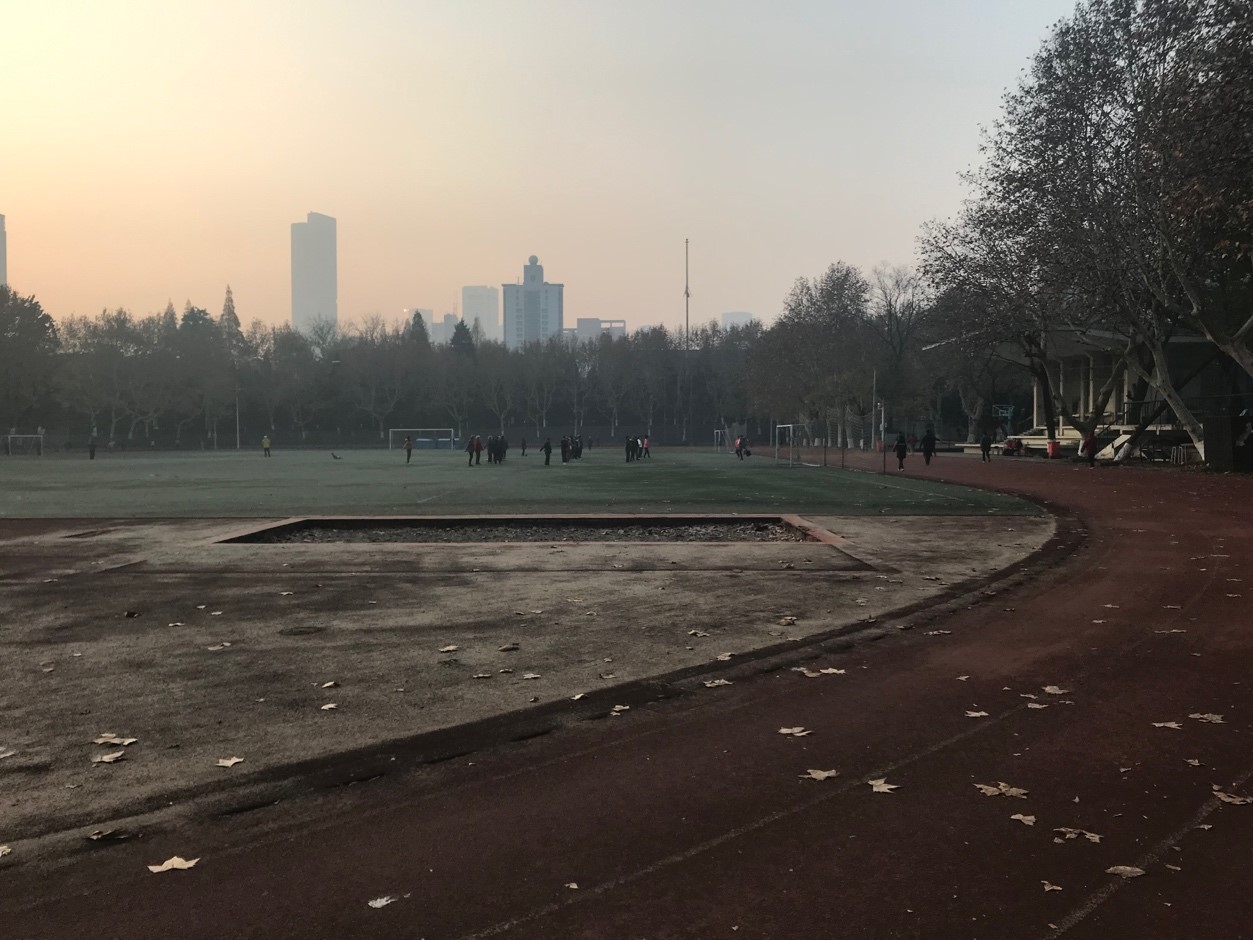
I start the morning with a run on the Nanjing University track or by going to the Hopkins-Nanjing Center fitness center. As the weather has gotten colder, fewer people have been on the track. Luckily, this morning lots of people were out walking, running, and dancing.

Nanjing University’s track in the morning

8:00 a.m. International Political Economy (IPE)
On Wednesdays I have an early start with my IPE class. This week we have been finishing up topics on maritime issues and trade, and applying theories we studied at the beginning of the semester to events and policies. Today we focused on different states’ policies in the Arctic.

9:50 a.m. International Relations of East Asia
Our class focuses on Northeast Asian relations, particularly on the Korean Peninsula. In our last class we all presented on our final paper topics. Since several students are studying cooperation mechanisms in East Asia, our professor discussed fundamental features and barriers to cooperation in East Asia.

12:00 p.m. Lunch

Around noon I head to lunch at the Hopkins-Nanjing Center cafeteria. Lunch is probably one of the busiest times in the cafeteria because everyone goes to eat right after class. Professors and students catch up with one another and continue class discussions over lunch.

A study space in the Hopkins-Nanjing Center Library

12:30 p.m. Homework
This semester I only have morning classes, which means I usually start preparing for other classes after lunch each day. Today I have to go over my readings for tomorrow’s law class. We just started a unit on internet law and how cyberspace activities could be governed internationally. Once I finish, I start on readings for Friday morning’s International Political Economy class.

There are lots of places to study on campus. Sometimes I’ll study in my room, but there are also various spaces in the library for students to study. If I feel that I need an extra quiet space, I usually go to my study carrel. Master’s students can get a carrel to study in, which is a room that is shared by three students, each assigned their own individual desk. The carrels are available for students to study any time—day or night.

Professor Andrew Mertha giving a lecture on China’s relationship with Cambodia

7:00 p.m. Lecture
Each Wednesday afternoon from is blocked out for visiting lectures at the Hopkins-Nanjing Center—often professors from universities in China and abroad. Tonight we heard from the new China Studies director at Johns Hopkins SAIS, Professor Andrew Mertha, talk about his research on Chinese-Cambodian relations. Lots of students were excited to hear about China’s relationship with Cambodia from an expert in the field.

8:30 p.m. Moot Court

I am a member of the Jessup International Law Moot Court team. Our group usually meets at least once per week to discuss, research, and write, but I also try to do some work on the case each day. Often that means reading about other cases, then adding to my written arguments.

9:45 p.m. Wind Down
At the end of the day my roommate and I are usually both back in our room. Before we go to sleep, we talk about different things that we did that day, as well as what we’re doing later in the week.

Written by Hope Parker, MAIS ‘20

Hopkins-Nanjing Center Master of Arts in International Studies Thesis Tutorial Course

Student blogger Hope Parker reflects on the required First-Year Interdisciplinary MA Tutorial Course. 

Every first-year Master of Arts in International Studies (MAIS) student at the Hopkins-Nanjing Center is required to take the interdisciplinary MA Tutorial Course during their first year. Before starting the course, I assumed it would be a research methods class in preparation for writing our theses. As it turns out, although master’s students do take a separate class that includes research methods later on in their studies, the tutorial is meant to help students start thinking about a variety of questions that we may encounter while researching and writing our theses. Given that every master’s student is required to take the course, there are Chinese and international students in each section, and the course is co-taught by an American and a Chinese faculty member. The professors take turns leading the course in English and Chinese, based on English and Chinese readings. Chinese and international students have discussions using their target languages.
 

As an interdisciplinary course, the tutorial covers topics on a variety of social sciences, frequently focusing on different theories’ applicability in China, the United States, and the rest of the world. The structure prompts an examination of these theories against students’ existing understandings of an issue within a particular cultural context. Explaining how I understand social science theories based on my own cultural background in Chinese has been more challenging than I anticipated, but has made me aware of how closely language and culture are related. At the beginning of the course, I would bring up ideas that are inherently based on my American education and background. However, raising those ideas in Chinese to people who do not have the same background made me realize that what I said may not have meant the same thing for my classmates as it did for me.

Taking the tutorial course requires me to think about ideas and explain them in a more systematic fashion, reflecting not just on my perspective, but why I have that perspective. I then do the same when listening to my classmates, attempting to make my ideas as clear as possible and understand others’ perspectives as well as I can. These class discussions will help my thesis by giving it more nuanced perspectives, not just in terms of varying social science theories, but also based on their applicability to different situations. More generally, I find the class to be a good listening and discussion exercise.

The Hopkins-Nanjing Center’s cross-cultural setting provides a unique forum for examining arguments in a methodical way. In the tutorial course and at the Hopkins-Nanjing Center, having fellow classmates ask me a question about my perspective has prompted me to reflect on what experiences and lessons I experienced that may be common within the United States, but not elsewhere. As an international student at the Hopkins-Nanjing Center, not only have I learned a lot about China and Chinese society, but I have also been encouraged to think more deeply about my own background.

Written by Hope Parker, Master of Arts in International Studies ‘20