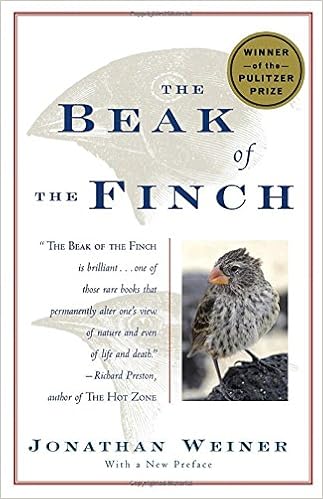
The Beak of the Finch by Jonathan Weiner
biology evolution Finch Galapagos nonfiction scienceSummary from Amazon:
"On a desert island in the heart of the Galapagos archipelago, where Darwin received his first inklings of the theory of evolution, two scientists, Peter and Rosemary Grant, have spent twenty years proving that Darwin did not know the strength of his own theory. For among the finches of Daphne Major, natural selection is neither rare nor slow: it is taking place by the hour, and we can watch.
In this dramatic story of groundbreaking scientific research, Jonathan Weiner follows these scientists as they watch Darwin's finches and come up with a new understanding of life itself. The Beak of the Finch is an elegantly written and compelling masterpiece of theory and explication in the tradition of Stephen Jay Gould."
Reviews:
New York Times: "In Darwin's Footsteps": https://www.nytimes.com/2014/08/05/science/in-darwins-footsteps.html
Kirkus Review: https://www.kirkusreviews.com/book-reviews/jonathan-weiner/the-beak-of-the-finch/
Kirkus Review: https://www.kirkusreviews.com/book-reviews/jonathan-weiner/the-beak-of-the-finch/
Videos:
(2014) The Origin of Species: The Beak of the Finch: https://vimeo.com/81535847
(2017) NY Times: Feather Fancy: https://www.nytimes.com/video/science/100000005122187/feather-fancy.html
(2017) NY Times: Feather Fancy: https://www.nytimes.com/video/science/100000005122187/feather-fancy.html
Pulitzer Prize Winner for 1995 in General Nonfiction: http://www.pulitzer.org/winners/jonathan-weiner
Author, Jonathan Weiner's, website: http://www.jonathanweiner.com/
2016 Article about Rosemary and Peter Grant:
"The Legendary Biologists Who Clocked Evolution's Astonishing Speed":
https://www.wired.com/2016/10/legendary-biologists-clocked-evolutions-astonishing-speed/

Nature (2016) "The Evolution of Darwin's finches tracked at genetic level":
http://www.nature.com/news/evolution-of-darwin-s-finches-tracked-at-genetic-level-1.19795
Science News: "Gene Found that Controls Beak Size in Darwin Finches":
https://www.sciencenews.org/article/gene-found-controls-beak-size-darwins-finches
Guided Reading Questions for AP Biology: https://croteaubio.wordpress.com/ap-bio-tutorials/beak-of-the-finch-chapter-questions/
Discussion Questions (by John, who will be leading the discussion):

1. Darwin’s theory of evolution, natural selection, and origin of species were based on interpretations of observations. How is this different from normal scientific process? What is the role of experimentation for proving and supporting theories?
2. What were the Grants’ and their collaborators critical contributions for demonstrating these phenomena? Why did they focus on Galapagos finch species? How were beak sizes and shapes used as critical determinants of divergences and speciation?
3. What role did weather and climate shifts play in their observations of selection? Similarly, what were the accompanying changes in vegetation effect selection?
4. How did the interplay of bees and nectar drinking finches demonstrate that different species can exert selective pressure on each other, not only intra-species effects?
5. What are the characteristics of a species?
6. How may species’ boundaries be tested and sometimes stretched?
7. What are the differences in natural selection versus sexual selection and how do they combine to produce diversity and speciation?
8. How did the African guppies studies conducted by Endler support the Grants’ conclusion?
9. How did the fruit fly studies contribute to understanding selection and formation of species?
10. In the 20 years since this book was published, genetic sequencing of DNA has become a very powerful tool for biologists, enabled by complete DNA analysis of individual organisms. How might this type of analysis affect our understanding of natural selection and the studies conducted in this book?
11. The book includes numerous, diverse examples separate from the finches of the Galapagos of selection pressures leading to divergence including for bacteria (antiobiotic resistance), insects (pesticide resistance), moths (color change), elephants (loss of tusks). How do these phenomena extend and mostly reinforce the observations of the Grants?
12. The subject of evolution is still difficult and controversial for many people. Why do people for the most part appear to understand and accept the observations of selective pressure and divergence, such as those described in this book, yet reject evolution?